
Quick answer
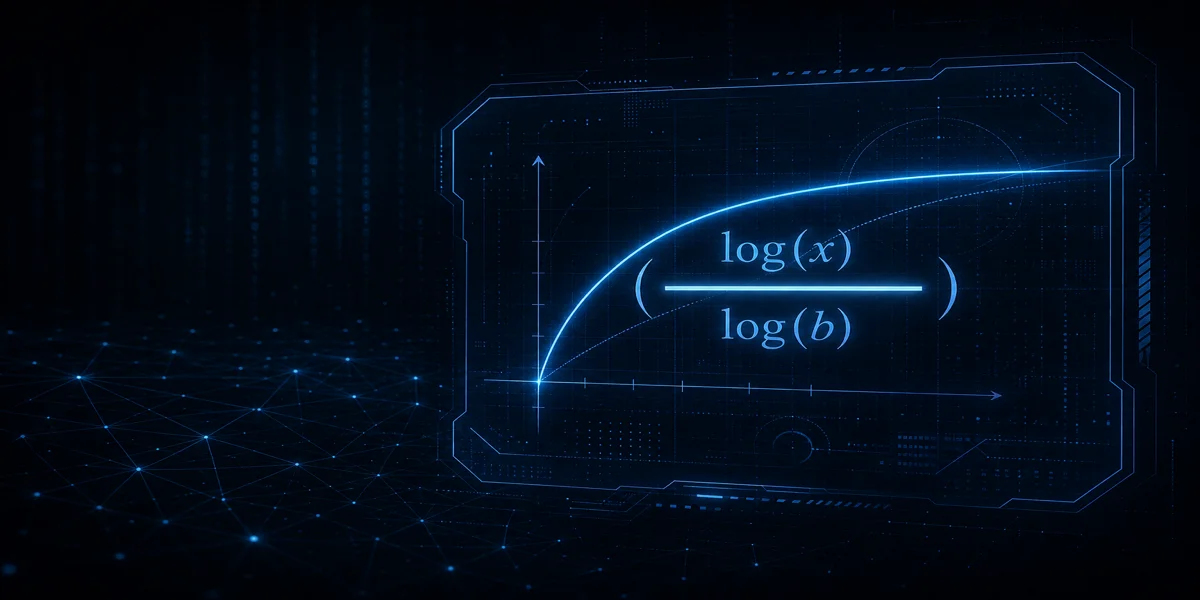
For positive x and bases a, b (not 1): logb(x) = loga(x) / loga(b).
Formula
- log_b(x) = log_a(x) / log_a(b)
- Meaning: same logarithm, different base label
- Used for calculator evaluation and comparisons
Introduction
Logarithms appear early in algebra, then return in statistics, chemistry, physics, and computer science with different base conventions. Students often know what a logarithm means in one base while an exam question asks for another.
The change of base formula is the standard identity for logarithm base conversion. It does not approximate a new value; it re-expresses the same logarithmic relationship using a base you can evaluate on your calculator or in your notes.
After the definition below, many readers open the change of base formula reference to compare base 10, natural log, and general forms on one page, then follow the step-by-step method for using the formula when they are ready to work problems.
You can test any valid triple (x, a, b) immediately with the Change of Base Formula Calculator at the top of the home page, or jump straight to calculator in the home page hero.
Definition, meaning, and why it is used
Definition: logb(x) is the exponent you raise b to in order to obtain x. The change of base formula writes that exponent using logarithms measured in a convenient auxiliary base a.
Meaning in words: you are translating between two counting systems for exponents. The argument x stays fixed; only the base label on the logarithm changes.
Why the formula is used: handheld keys are usually log (base 10) and ln (base e). Word problems may specify base 2, 5, or another positive base. Without conversion, you cannot compare or compute those logs on standard keys.
Logarithm base conversion also appears when spreadsheets, programming libraries, or engineering formulas output natural logs but reports require common logs.
Real-world applications include algorithm analysis (binary logs), decibel and pH scales (base 10 thinking), and growth models that print ln first.
Keep domain rules visible: x must be positive; bases must be positive and not equal to 1. Violating these rules is the fastest way to get nonsense on a calculator.
Formula statement and notation
- log_b(x) = log_a(x) / log_a(b)
- Calculator (base 10): log_b(x) = log(x) / log(b)
- Natural log: log_b(x) = ln(x) / ln(b)
Subscripts matter. log2(8) and log10(8) are different numbers even though the argument 8 is the same.
Each line above is equivalent when inputs are valid; pick the form that matches your calculator keys.
If a problem already states loga(x), that value can sit in the numerator when a is your original base.
From definition to practice
- Read the logarithm carefully. Circle the argument x and identify the base written in the problem before you choose a new base b.
- Choose an auxiliary base for evaluation. Pick base 10, base e, or the original base a depending on which keys or given values you have.
- Apply the ratio. Compute loga(x) divided by loga(b) using identical auxiliary base throughout.
- Verify on simple cases. When x is a power of b, the converted log should be an integer. Use calculator in the home page hero to confirm decimal problems.
Worked illustration
Suppose log10(100) = 2. To express the same information in base 2 notation, write log2(100) = log10(100) / log10(2) = 2 / log10(2).
The division does not change the underlying exponent relationship; it only changes how the exponent is measured.
Try rewriting one more triple by hand before you rely on calculator keys alone.
Share this page